Inside the Black Velocity Concept
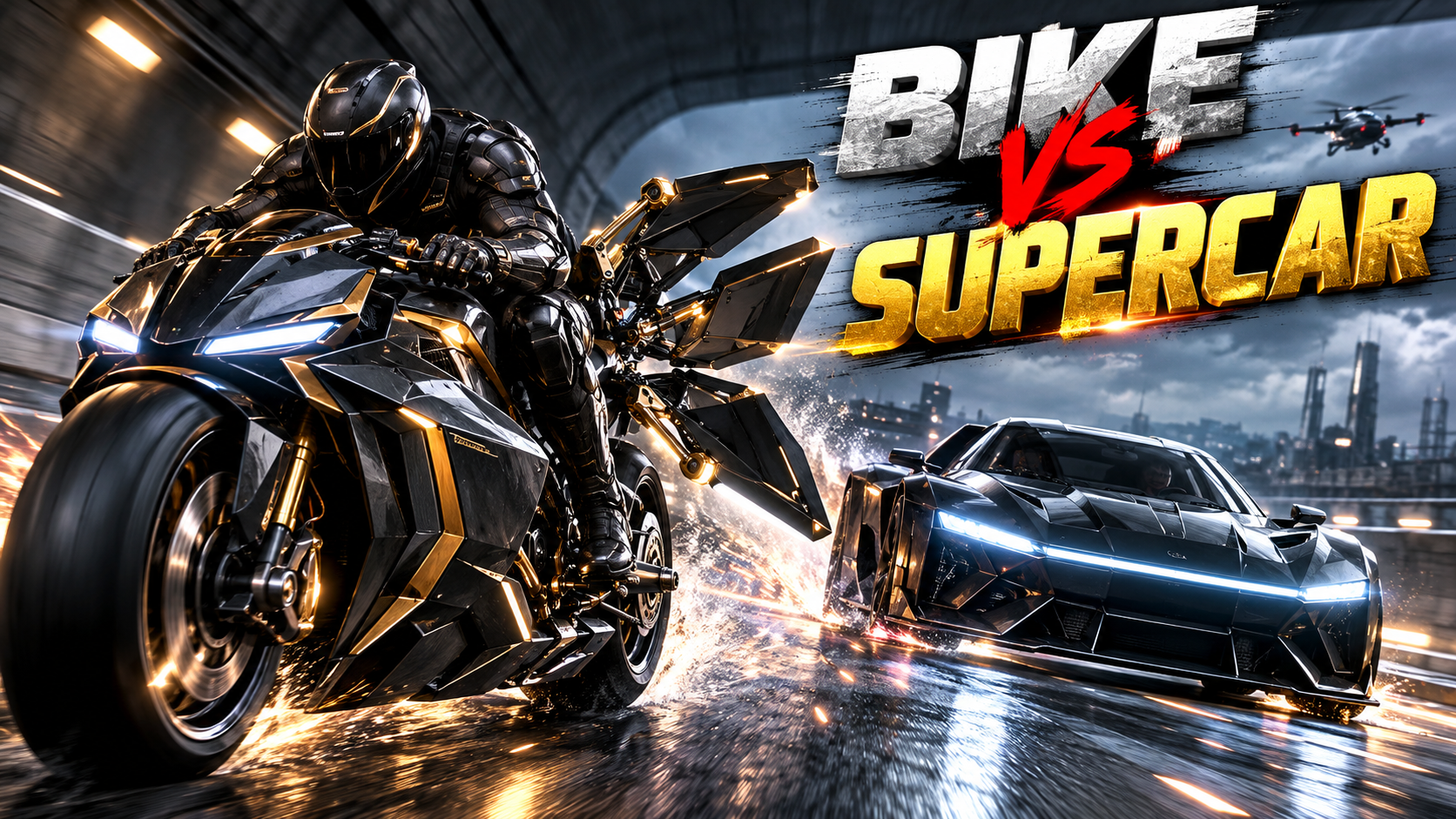
Black Velocity is a cinematic science-fiction action concept built around a futuristic motorcycle, an armored supercar, and a high-speed pursuit across an empty highway and through a dark concrete tunnel. Its visual identity combines black bodywork, metallic-gold details, cool white lighting, and restrained red taillights.
The concept follows nine connected scenes. Each scene uses a different camera position or vehicle action while preserving the established designs of the rider, motorcycles, and supercar. The goal is to create a coherent cinematic sequence rather than a collection of unrelated vehicle shots.
Mechanical details play a central role. The motorcycle features deployable rear aerodynamic panels, while the supercar uses angular bodywork, a continuous front LED strip, and upward-opening scissor doors. Every movement should remain visually grounded in the vehicle's established design.
Keep the characters and vehicles consistent across all nine scenes. Change the camera, framing, lighting response, and required action without redesigning the established elements.
Visual Identity and Color Palette
The visual direction uses a desaturated, high-contrast palette. Black and graphite dominate the vehicles and environment. Metallic gold defines the primary motorcycle's mechanical accents. Cool white LEDs provide the main vehicle lighting, while red remains reserved for rear lights.
Black and Graphite
Matte-black armor, dark vehicle surfaces, concrete structures, and deep shadows establish the primary visual identity.
Metallic Gold
Gold trim and highlighted mechanical joints create contrast against the motorcycle's dark aerodynamic fairings.
Cool White LEDs
Integrated headlights, the supercar's front light strip, and tunnel lights define the vehicles and their surroundings.
Overcast Highway
Soft daylight, occasional damp road patches, concrete barriers, and controlled reflections create a restrained cinematic atmosphere.
Lighting changes naturally as the chase moves from the open highway into the tunnel. Outside, the vehicles receive soft, overcast daylight. Inside, overhead practical lights create stronger highlights and reflections on the bodywork and windshield.
The Vehicles and Character Design
The Primary Rider
The lead rider is an adult male wearing a matte-black tactical exosuit, armored gloves, reinforced boots, and a fully enclosed black helmet with a narrow dark visor. His face remains hidden throughout the sequence.
The suit, helmet, body proportions, and accessories remain unchanged in every scene. This continuity helps the audience recognize the same rider even when the camera shifts between close-ups, rear tracking shots, and aerial views.
The Black and Gold Superb ike
The primary motorcycle uses angular aerodynamic fairings, exposed mechanical joints, wide performance tires, integrated white LED headlights, and a sculpted rear section with deployable wing-like panels.
Its frame, wheelbase, fairings, lights, and color distribution must remain consistent. The rear panels unfold through visible hinges and articulated linkages. The transformation should appear to follow a defined mechanical sequence, with the panels locking into place.
The Armored Supercar
The supercar has a low stance, sharp geometric bodywork, dark glass, large performance wheels, a continuous white front LED strip, and a red rear light bar. Its scissor-style doors open upward to reveal a dark interior.
The design should remain original and fictional. Its silhouette, dimensions, wheels, lighting, and body panels must stay consistent throughout the chase.
The Secondary Motorcycle
The second motorcycle shares the black-and-gold visual direction but remains a distinct vehicle. Its rider wears a separate matte-black armored suit and a fully enclosed helmet. Whenever this motorcycle appears, preserve its identity and distinguish it clearly from the primary bike.
Use the same established vehicle designs as fixed references. Do not introduce new body panels, change wheel designs, alter helmet shapes, or shift the color palette between shots.
The Nine-Scene Black Velocity Chase
The sequence progresses from an introduction to the primary motorcycle, through mechanical and vehicle reveals, into a coordinated pursuit. It finishes inside a tunnel, with the vehicles accelerating toward the exit and the story left open for a continuation.
SCENE 01 Highway Acceleration
A wide, low-angle tracking shot follows the primary rider accelerating along an empty highway. The rider leans forward, the motorcycle remains fully assembled, and realistic suspension movement and tire contact communicate speed.
SCENE 02 Mechanical Transformation
A tight mechanical close-up shows the motorcycle's rear aerodynamic panels unfolding while it continues moving. Hinges and articulated linkages remain visible, gold details catch brief reflections, and the panels lock into position.
SCENE 03 Supercar Reveal
A low-angle hero shot introduces the black supercar on the highway shoulder or a wide empty lane. Its scissor doors rise smoothly, exposing a dark engineered interior as the white front LED strip illuminates through light road mist.
SCENE 04 Twin Motorcycle Run
A rear tracking shot follows both motorcycles riding side by side. They maintain parallel trajectories and clear separation while the camera moves close to road level. Rear lights, tires, and body panels remain consistent.
SCENE 05 Supercar Pursuit
The supercar accelerates along the highway while the primary motorcycle closes the distance from behind. The car's red rear light bar retains its established design, and the spacing between vehicles changes through believable acceleration.
SCENE 06 Aerial Highway View
A stable top-down drone shot shows the curving highway and all three vehicles following the same direction. A small surveillance drone appears above and behind the group, adding scale without obscuring the chase.
SCENE 07 High-Speed Drift
An extreme low-angle close-up focuses on the supercar's front wheel during a controlled drift. Tire deformation, steering geometry, and suspension compression should look physically plausible. Sparks appear only if road contact justifies them.
SCENE 08 Tunnel Entry POV
An interior dashboard view shows restrained digital instrumentation and subtle blue-white lighting as the supercar enters a concrete tunnel. Overhead lights pass naturally, and the windshield reflections change with the environment.
SCENE 09 Tunnel Chase Finale
The supercar and motorcycles continue through the tunnel over damp asphalt. White overhead lights reflect across the road and vehicle surfaces. The camera tracks between rear and side angles before all vehicles accelerate toward the tunnel exit.
Each scene has a distinct visual purpose. The opening establishes the motorcycle, the middle scenes introduce the other vehicles and increase the pace, and the tunnel sequence provides a controlled final escalation.
Camera Movement and Action Continuity
Camera movement determines how the audience experiences the speed and mechanical detail. Black Velocity uses several deliberate shot types instead of relying on continuous camera shake or excessive motion blur.
- Low-angle tracking. Establishes the motorcycle's size, road contact, and forward acceleration.
- Mechanical close-ups. Reveal hinges, joints, fairings, and deployable panels.
- Hero reveal. Presents the supercar's shape, lighting, and upward-opening doors.
- Rear pursuit tracking. Communicates distance and relative speed between vehicles.
- Aerial top-down view. Clarifies the highway layout and positions of all three vehicles.
- Vehicle-mounted POV. Places the audience inside the supercar during tunnel entry.
- Extreme low-angle detail. Emphasizes the front wheel and suspension during the drift.
Maintain Screen Direction
Connected shots should preserve the direction of travel unless a deliberate turn or camera transition explains the change. If the supercar moves toward the tunnel in one shot, the next shot should not make it appear to reverse direction without cause.
Control Motion Blur
Use blur to communicate speed in the road, background, and fast-moving environmental details. Keep the rider, vehicle silhouette, and important mechanical features readable. Excessive blur can hide continuity errors rather than create convincing movement.
Keep Continuous Takes Physically Coherent
A continuous camera move should have a plausible path. Avoid sudden camera jumps, unexplained changes in height, or impossible transitions through vehicle structures. Separate shots can use different angles, but their starting and ending positions should support the same action.
Mechanical Realism and Vehicle Physics
The visual design depends on more than detailed surfaces. Vehicle movement must support the weight, geometry, and mechanical structure shown on screen. This is especially important during acceleration, panel deployment, and the supercar's controlled drift.
Motorcycle Dynamics
The tires should remain in contact with the road, and the suspension should react to surface changes and acceleration. The rider's forward lean should fit the direction and intensity of movement. The motorcycle must retain the same wheelbase and frame geometry while the rear panels deploy.
Deployable Aerodynamic Panels
The transformation should communicate a clear sequence of motion. Panels rotate around visible hinge points, mechanical linkages move with them, and the final position looks secured. Avoid panels that appear from nowhere, pass through the bodywork, or change shape during deployment.
Supercar Drift
The drift should remain controlled and grounded. Steering angle, tire deformation, and suspension compression need to support the car's direction of movement. The wheels should not float above the asphalt, and sparks should not appear without a plausible point of contact.
Environmental Reflections
Vehicle surfaces should respond to their surroundings. Overcast skies create broad, soft reflections on the exterior. Tunnel lighting produces successive highlights that move across the car and motorcycle as they pass beneath overhead fixtures.
Prioritize coherent movement, recognizable vehicle geometry, and consistent lighting over excessive effects. The chase becomes more convincing when every action has a visible physical cause.
Maintaining Visual Consistency Across Nine Scenes
Multi-scene AI video production can introduce unwanted changes in faces, clothing, vehicle proportions, lights, and mechanical components. Black Velocity addresses this challenge through fixed character and vehicle specifications.
Use the project description as a reference sheet for every scene. Repeat the relevant identity details in individual prompts rather than relying on a previous scene to establish the design.
Character Continuity
- Keep the primary rider's helmet fully enclosed in every shot.
- Preserve the same exosuit, gloves, boots, and body proportions.
- Keep the secondary rider visually distinct.
- Do not reveal the primary rider's face.
Vehicle Continuity
- Preserve the primary motorcycle's frame, fairings, wheelbase, and gold trim.
- Keep the supercar's silhouette, wheel design, LED strips, and scissor doors unchanged.
- Maintain the secondary motorcycle's established black-and-gold styling.
- Keep the vehicle damage state consistent across connected scenes.
Environment Continuity
- Maintain overcast daylight on the highway.
- Preserve the road markings, asphalt texture, and concrete barriers.
- Transition into the same dark concrete tunnel.
- Keep damp patches, reflections, and lighting direction coherent.
- Exclude pedestrians and unrelated traffic.
Negative Prompting
The project also specifies visual defects to avoid, including malformed hands, extra limbs, distorted proportions, changing helmets, mismatched wheels, duplicated vehicles, flickering LEDs, floating tires, impossible suspension movement, sudden teleportation, excessive sparks, oversaturated colors, text, subtitles, watermarks, and logos.
These exclusions help define what the finished sequence should avoid. They do not guarantee that every generated frame will be correct, so inspect each scene before assembling the final edit.
A Practical Workflow for Producing Black Velocity
A structured workflow makes it easier to identify continuity problems before they spread across the full sequence.
- Establish the references. Finalize the rider, both motorcycles, and supercar descriptions before generating individual scenes.
- Generate the opening shot. Check the primary rider's proportions, motorcycle silhouette, color distribution, road contact, and overall visual style.
- Validate the mechanical transformation. Inspect the second scene for coherent hinge movement and stable motorcycle geometry.
- Confirm the supercar design. Review its silhouette, front LED strip, wheel design, and scissor doors before using it in the pursuit.
- Build the chase in sequence. Generate the pursuit and aerial shots with clear vehicle positions and consistent direction of travel.
- Review the drift and tunnel entry. Check tire contact, reflections, dashboard appearance, and lighting transitions.
- Inspect the final sequence. Compare all nine scenes for character identity, vehicle geometry, weather, lighting, and screen direction.
- Assemble and review the edit. Check transitions, motion continuity, sound timing, and the final tunnel exit before publication.
Final Quality-Control Checklist
- The primary rider retains the same helmet and exosuit.
- The motorcycle's transformation follows a coherent mechanical sequence.
- The supercar remains recognizable across every appearance.
- Both motorcycles maintain clear spatial separation.
- Vehicle movement matches road direction and camera framing.
- Lighting and reflections match the highway or tunnel environment.
- No unexplained damage, duplicated vehicles, or sudden design changes appear.
- The final shot provides a natural continuation point.
What Defines the Black Velocity Experience
Black Velocity combines a consistent futuristic vehicle design with a nine-scene cinematic pursuit. Its black-and-gold superbike, armored supercar, mechanical transformation, and tunnel finale provide the visual structure for the sequence.
The strongest execution will depend on clear camera choices, grounded vehicle movement, consistent character and vehicle references, and careful scene-by-scene review. These elements keep the sequence coherent from the first highway shot to the final tunnel exit.
For creators exploring AI-assisted filmmaking, the project offers a structured example of how detailed reference specifications can guide a multi-scene science-fiction action concept.
Frequently Asked Questions
What is Black Velocity?
Black Velocity is a cinematic science-fiction action concept featuring a futuristic black-and-gold motorcycle, an armored black supercar, a second motorcycle, and a nine-scene highway and tunnel chase.
How many scenes are in the sequence?
The sequence contains nine scenes, from highway acceleration and motorcycle transformation to a supercar drift, tunnel entry, and final chase.
How does the project maintain vehicle consistency?
It uses fixed descriptions for the vehicle silhouettes, body panels, wheels, lighting, colors, and mechanical features. Each scene must preserve these specifications while changing only the required action and camera framing.
What visual style does Black Velocity use?
The project uses cinematic photorealism, a desaturated black and graphite palette, metallic-gold accents, cool white LEDs, overcast daylight, and high-contrast concrete tunnel lighting.
Why is mechanical realism important in the chase?
Believable tire contact, suspension response, panel deployment, steering geometry, and vehicle spacing help the action feel coherent and keep the vehicles visually grounded.
Explore the Engineering Behind Tomorrow
Follow Origin of Tomorrow for technology stories, engineering explanations, and AI-assisted creative projects that examine how futuristic concepts are designed and visualized.
Explore More Articles

Comments (0)
No comments yet. Be the first to share your thoughts!
Leave a Comment